Litreature Review
Table of Contents
1.1 Commercial Studios
1.2 Home Studios
1.3 Digital Technologies
1.4 Hardware and Software Emulation
1.5 Acoustics
1.6 Acoustic absorption and material
1.7 Conclusion


1.1 Commercial Studios
Lefford & Thompson (2018) article is about the decision-making that a producer and audio engineers face in a music production environment where there are uncertainties, risks and a basic or lack of a goal in terms of musical arrangement. The way that the musician and the producers must work together is interesting as there is a demand for professionalism, as collaboration between the team of engineers and the musicians must communicate to define the intentions, ideas, visions and understand the knowledge present. (Lefford & Thompson, 2018; Bell, 2014; Camilleri, 2010; Iverson, 2017; Shepherd, 2011)
Lefford & Thompson (2018) states that the pressures in a studio are high, as there is a need to perform well as an engineer or producer, as reputation plays a big part into what and how much work is given, as well as the stakeholders may have different ideas for the music as since they typically finance the recording project, they want to make sure it meets their market-based goals. (Lefford & Thompson, 2018)
Lefford & Thompson (2018), Thompson & Lashua (2014) and Harrison (2014) discuss Ethnographic approaches to researching studios, they agree that studios are a place of introverted creativity, sensitive to outside interference. You would not interview a Lion on its eating habits, you would watch it from a far and not interfere. (Lefford & Thompson, 2018; Thompson & Lashua, 2014; Harrison, 2014).
Lefford & Thompson (2018) and Thompson & Lashua (2014) approach to ethnographic research was to record videos and audio of the recording sessions and collect data on the sessions by reviewing the footage and audio. Whereas Harrison (2014) approach was different as Harrison worked with them to create the record, becoming a part of the creative process rather than a researcher, this fits the not influencing approach as he was not an outsider but a factor of the creative process and blended in, meaning he did not negatively influence the recordings. (Lefford & Thompson, 2018; Thompson & Lashua, 2014; Harrison, 2014).
With the evolution of technologies and the debut of DAWs, studios have become a dying breed, as it is possible to build a computer-based home studio on a smaller budget allowing musicians to become an all-in-one musician/ producer. (Bell, 2014; Hidalgo, 2013; Watson, 2013; Burgess, 2008; Long, 2013; Robair, 2012; Walzer, 2016; Wilson, 2011; Herbst & Albrecht, 2018).


1.2 Home Studios
Walzer (2016) and Burgess (2008) articles state that financial situations are lackluster for producers, and they are often isolated and technologically lacking, but they also offer a wealth of creativity and entrepreneurship. These producers are developing their recording and promotional skills through dedication, creative marketing, and desire to connect with similar minded peoples (Walzer, 2016; Burgess, 2008; Wilson, 2011). This is due to the fact of recent recording technologies being more affordable and with the internet it has forced producers to adapt and become a business with them needing to do their own connections, revenue, and marketing. (Walzer, 2016; Burgess, 2008; Wilson, 2011)
Home studios produce creativeness and high quality music through its accessibility, simplistic functionality, and their ability to connect to the internet. Due to music software being cheap and accessible, plus tutorials for recording, distribution and promotion has allowed producers to be self-serving and not need to rely on anyone to get their music out there. (Walzer, 2016; Burgess, 2008) Burgess adds that pre-home studios, producers had a team to operate the studio roles but due to digital equipment being simpler, one person can do it all, another benefit of being a producer/engineer combo and owning a studio reduces the budget costs as there is no additional people costs and the budget can be pay for the producer and studio. (Burgess, 2008)
Figure 1 DIY Bedroom Studio
Wilson (2011) article backs up the points made about producers being self-serving by discussing a rap group called All4One, who have built a studio in their bedroom, this is interesting as bedrooms are stated to be a personalized safe space (Wilson, 2011; McRobbie, 2000) Their studio has a DIY (Do it yourself) vocal booth made from acoustic panels, a microphone, and mic stand with a laptop set up outside the booth (Figure 1). All 4 One set up their own marketing social media to communicate with fans and the community. Wilson states that the underground hip-hop scene feel strongly about independent in terms of their music. (Wilson, 2011; Mitchell, 2003)
Figure 2 Recommended Design Levels
Unfortunately for All4One, they are limited to producing their music at lower levels due to restrictions of volume in neighboring areas, which is around 30dBs to 35dBs for bedrooms. (Figure 2) (Anderton, 2010; Long, 2013; Australian Government, 2013)
A method Home Studio users do to avoid restrictions is by using headphones for producing since they focus the sound only for the wearer (Anderton, 2010). Headphones also remove acoustics from the equation since the sound will not be traveling around the room. (Anderton, 2010; Everest, 2015; Long, 2013; Newell, 2017) But a Psychoacoustic issue with headphone mixing is that since the sound is in your head it means that there is no cross-feed and the mix will sound unnatural through speakers, this is often referred to as Headphone mixes. (Anderton, 2010)
Figure 3 Equilateral Triangle position (Distance from person varies from speakers to speakers.)
An issue from figure 1 is the configuration of the room, as it is not properly configured for the optimal listening position, the speakers are placed on the floor and cannot be in the Equilateral Triangle position (Figure 3) (Sonarworks, 2019; Robair, 2012) This is the optimal speaker position as it allows for detailed high frequency listening as they are directional and off axis listening results in less detail. (Sonarworks, 2019) Another issue for home-based studios are parallel walls, low ceilings, and modal issues (Robair, 2012; Everest, 2015; Newell, 2017)
Robair (2012) also states that to try your best to work around these issues as they can be unavoidable, like room dimensions and with careful planning can result in the best home studio that it can be. (Robair, 2012). This compromising statement fits with the Lo-fi genre, which is music that is defined in its opposition to state-of-the-art recording equipment thus resulting in noise and artifacts that are usually undesirable. (Supper, 2018; Taylor, 2015). Lo-fi music a counterpoint to the historical developments of higher quality music equipment and it is shown in Taylor (2015) article that young university students find new technologies less interesting but are drawn in by older, poorer quality equipment. This and the advent of affordable equipment has led to lo-fi music being very popular. (Supper, 2018; Taylor, 2015; Bell, 2014; Herbst and Albrecht, 2018; Watson, 2013; Burgess, 2008; Hagan, 2016; Theberge, 2004).


1.3 Digital Technologies
1.3 Digital Technologies:
Despite young people disregarding current technology for vintage lo-fi gear (Taylor, 2015), there is still a massive amount of interest in digital technology, as it has become the meta for recording. (Order, 2016; O’Gardy, 2019; Lau, 2012; Hagan, 2016). As digital music production is now no longer a technology that helped with issues with tape but now taken over tape as a recording device in most studios. (Hagan, 2016) A factor of this is the affordability of computers and lack of issues unlike Tape Machines. (Hagan, 2016).
There are advantages and disadvantages to both digital and analogue equipment, as pre-digital, hardware units were specific in their functionality and had to be side-chained to a desk whereas now you can acquire digital multi-effects and plugins, which simplify the process and offers more functionality. (Lau, 2012). Another advantage digital has is its quietness and clean processing, where hardware effects will always have a small noise floor. (Lau, 2012)
But a massive disadvantage to software is processing power, as these plugins and other types of software require a CPU (Central processing unit), RAM (Random access memory) and a hard drive to store themselves and run on. Which has limits and even powerful computer can only handle so much until it crashes, a way around this is to print the effect but that means you cannot alter that effect afterwards. Whereas Hardware has no dependencies expect for itself. (Lau, 2012) But it is worth noting that computer CPUs, Hard drives and RAM are constantly improving. (Woszczyk & Leonard, 2012).
Hardware eventually dies out and breaks, but software can continue to work forever unless the computer breaks, but the hard drive can be recovered, or the software can be stored elsewhere for futureproofing. These hardware imperfections have unique quirks and characteristics, which is why many hardware units are so sought after, because they can offer a distinctive sound, and every hardware unit will sound different, but software will always sound the same and not unique, and even software designed to emulate hardware equipment cannot offer these quirky characteristics like real hardware units. (Lau, 2012)
With the advent of digital technologies, new roles in the music industry have come about, such as the CMDs (Computer Music Designer), where in the past, Studios were run by a team of individuals with different roles, now a CMD can do everything on their own with the new technologies available. (Zattra & Donin, 2016) CMDs have stated to be very much independent in their work and are also reluctant to share workplaces, tools, practices, and ideologies, which is very much against the ideology of past studio practices. (Zattra & Donin, 2016)
As mentioned about software plugins, with them being not unique; research have been done to try and replicate the timbres of hardware equipment; an example being the Hybrid Guitar. Which was researched by Zoran & Paradiso (2011), who found that the Hybrid Guitar was successful in being a mix of digital and analogue’s functionality. This means that the advantages of being unique for hardware equipment will eventually be redundant. (Zoran & Paradiso, 2011)
Order (2016) article is interesting in how it brings up an advantage for digital technologies in the terms of manoeuvrability, as with a laptop, headphones, and internet, you can produce an album. Thus, allowing you to travel while you produce, which has advantages of giving you new perceptions which has shown to influence your mood and production (Order, 2016). This also gives the producer an ever-changing landscape to produce within, resulting in never getting used to and bored of their surroundings. And with these new technologies they can produce their music, advertise it, and connect with fans and contacts while on the move. Where a commercial studio and analogue equipment does not allow for manoeuvrability. (Order, 2016) Digital networks and software have been created to help with the new age, like Rocket Network, that was created to allow for file sharing and communication between producers around the globe. (Theberge, 2004) Rocket Network went under but Theberge does mention how more software-based networks and plugins will be created to further develop digital technologies. (Theberge, 2004)

1.4 Hardware and Software Emulation
In recent years, research has been done looking into digital modelling of analogue circuits of audio hardware equipment. (Damskagg, 2019; Karjalainen, 2006; Yeh, 2009; Zolzer, 2011). With the digital equipment and computer being implemented into recording studios and other places of audio and musical expression, the necessity of software emulation became apparent with a lot of music production was now being done digitally but the lust for more of an analogue timbre was still very sought after. (Taylor, 2015; Lau, 2012; Damskagg, 2019)
The two main approaches to acquiring digital models of hardware is the black box and white box modelling methods. The white box method is based on analysing the circuits of a piece of hardware equipment and simulating it, the models done by the white box method are of high accuracy, but it requires absolute knowledge on the hardware equipment and its nonlinear components that give it the unique timbre and it generally requires a lot of CPU usage. (Damskagg, 2019)
The black box method is based on measuring the input and output of a piece of hardware equipment while studying it. Black box is quite user friendly due to its general workflow and nature; it is used for emulating non-linear hardware systems but unfortunately fails most of the time to accurately the timbre of the hardware compared to the white box method which leads to audible differences between each method. It also worth mentioning that the black box method does not allow for parameter controlling and a separate modal has be made for every parameter option. (Damskagg, 2019)
Lloyd (2017) article has an interesting test done within it, as the work is based around the perception of impulse response (IR) with Violins. They created nine different versions of the same musical piece which had convoluted violin IRs of different lengths and the original recording placed within the nine versions. They then took these versions and played them to trained musicians and asked them to pick their preferred version based on their personal tastes rather than listening to them objectively. Lloyd found that there is a fine relationship between the acceptability of the violin sounds to the listener and the coefficients that are used to represent the violin’s body and timbre and that beyond a certain amount of coefficients; that acceptability does not change and there is no improvement to it. (Lloyd, 2017)
The work mentioned above is a clear indication that the software emulations of hardware equipment are very thorough and highly accurate in their recreations and works such as Lloyd (2017) article is giving evidence of the limits needed to accurately recreate instruments and hardware that are pleasing to trained participants. (Karjalainen, 2006; Yeh, 2009; Zolzer, 2011; Taylor, 2015; Lau, 2012; Damskagg, 2019; Lloyd, 2017)


1.5 Acoustics
Before discussing comparisons of acoustics in small and large rooms, it is important to understand what room modes and standing waves are. Stated in Everest’s (2014) Book (pp.229), Sound in rooms acts differently to sound in open spaces, as sounds will reflect on every surface, thus the SPL (Sound pressure level) will be a mix of direct sounds and reflected sounds, resulting in Modal Resonance. Modal Resonance is preferred frequencies where the energy is concentrated, thus when listening to anything in a room, those preferred frequencies will appear loader and mask other frequencies. (Everest, 2014; Newell, 2017; Yeary, 2014)
Standing Waves are frequencies that bounce back and forth from surface to surface, this is done with a wave hitting the right wall of a room and bouncing to the left wall, if the walls are solid and parallel walls, then the wave will travel back to the right wall, creating one wave traveling to the right wall and another to the left, this in turn makes a stationary wave that will not move, thus Standing Wave. To remove Standing Waves, consideration is needed, and Standing Waves are an issue for lower frequencies, below 300Hz. This causes an unbalanced frequency response as it will exaggerate or weaken the lower frequencies which can trick the engineer into hearing something that is not true and will ruin the mix whenever brought out of the studio. (Everest, 2014; Newell, 2017; Yeary, 2014)
Figure 4 Modes bouncing back and forth
Room Modes and Standing Waves are issues for audio engineers as the best tool engineers have is their ears and they need the rooms and equipment to give them the best representation of the sound sources so they can analysis the music and produce it (Everest, 2014; Newell, 2017; Yeary, 2014). Audio engineers need to be certain that they are hearing the direct sound when producing and not reflected sounds that influence the frequency content. When producing music in a small room, these problems are exacerbated since these waves can fit within the room and bounce back. (Everest, 2014; Newell, 2017; Yeary, 2014; Thomazelli & Bertoli, 2019) (Figure 4)
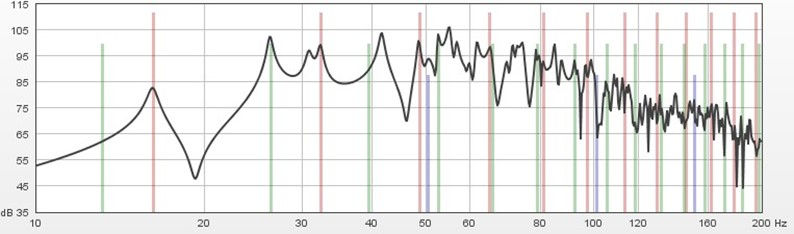
Which causes the frequency content of the room to be unbalanced, whereas larger rooms still have modes, but they are more spread out through the frequency band and therefore much more balanced and offer a much flatter response. (Everest, 2014; Newell, 2017; Yeary, 2014; Thomazelli & Bertoli, 2019; Roomeqwizard, 2018) To take a comparison from a previous study, here is a small rooms frequency response (Figure 5) and a large rooms (Figure 6)
Figure 5 Smaller Room Dimensions
Figure 6 Larger Room Dimensions
Research has been done to reduce modal interference, with acoustic panels and other more recent solutions like Sonarworks Reference Four. (Thomazelli & Bertoli, 2019; Sonarworks, 2019)
Acoustic panels are all designed to deal with a certain kind of frequency issue. this means that most rooms have a varied amount of acoustic treatment, but an experiment was done specifically with smaller rooms in mind, this experiment being a turnable Helmholtz absorber, which will be able to adjust for many different needs, resulting in a multipurpose and cost affective absorber, as buying many different absorber professionally made is expensive. They found that a single turnable absorber can be a solution for frequencies with high energy. (Thomazelli & Bertoli, 2019)
Sonarworks Reference Four, is designed to tweak the studio monitors based upon the reference response of the testing microphone that is supplied with the software. This is done by placing the microphone in the optimal spot within the studio and then it records the direct sound and reflected sounds of the room and then determines the frequency response of the room and tweaked the monitors to nullify any peaks and troughs in the room by counteracting them with the speaker’s frequency response. (Sonarworks, 2019)

1.6 Acoustic absorption and material
In Everest’s (2014) book, master handbook of acoustics, he has chapters dedicated to the acoustics of different types of spaces, the interesting chapters for this work is the home studio, small studio, and large studio chapters as these are being discussed within this work.
The home studio he mentions that low frequencies are going to be most trouble due the general size of a bedroom, garage, or basement being fairly small and being that these spaces are predetermined when bought, you have to compromise and do the best you can (Robair, 2012; Everest, 2014). Everest recommends bass traps as these will help with the low end of the room. But is also worth mentioning that in the small room studio, he recommends diffusers as they help split room resonances and help make the room feel more spacious due to it multiplying the room reflections. (Everest, 2014)
With large studios the modal resonance is not as big of an issue to solve due to it being more smoother in its response, but the acoustics still need to heavily considered just as much as smaller studios and perhaps more so due to the more professional nature of commercial studios and if the studio is not performing to maximum effect then is it worth being considered a professional recording space. (Everest, 2014) Within a commercial studio a larger number of absorption materials will be used to get the desired listening and recording environments and due to the larger size, the room within a room method will be most likely done to get excellent sound proofing and a deliberate reflective space; whereas smaller rooms cannot afford this luxury due to it being too small to get make it even smaller. (Everest, 2014)
Owsinski’s (2013) LinkedIn learning music studio setup and acoustics course has an interesting video within called Purchasing acoustic material where he breaks down all the different types of material you can get for building your own acoustic panels, he compares them in terms of acoustic coefficients, general pricing and some pros and cons like irritation when constructing and pros like how sturdy the materials can be. (Owsinski, 2013)
This comparison between materials is effective as it helps studio owners and people who want to build a studio decide what materials are best for their situation in terms of budget and what will be most useful for their situation. (Owsinski, 2013)
1.7 Conclusion
Commercial Studios are being weaned out by the advent of digital technologies and home studios (Bell, 2014; Camilleri, 2010; Theberge, 2004; Herbst and Albrecht, 2018; Watson, 2013; Burgess, 2008; Hagan, 2016; Hidalgo, 2013; Long, 2013; Robair, 2012; Walzer, 2016; Wilson, 2011). As digital technology has simplified the act of recording, with DAWs being able to easily edit audio with slicing, time stretching and cutting; whereas with Tape these editing techniques were not easily pulled off and needed extensive practice, a massive advantage for DAWs over Tape is how the editing of audio is non-destructive, so if a mistake is made, then Control + Z will mend it, but if a mistake is made on Tape then that recording could be destroyed due to the destructive methods used to undo the mistake and if someone was to make a mistake trying to mend it, it could be lost completely. (Bell, 2014; Herbst and Albrecht, 2018; Watson, 2013; Burgess, 2008; Hagan, 2016; Theberge, 2004).
Digital technology is far more affordable resulting in people having home studios set up in their bedrooms on computer-based recording equipment. (Wilson, 2011; Mitchell, 2003; Walzer, 2016; Burgess, 2008)
Despite CMDs and home studio producers being much more independent than traditional producers and engineers, there is still a need for professional communication with the artists to achieve the goal of recording and creating music. (Zattra & Donin, 2016; Lefford & Thompson, 2018; Bell, 2014; Camilleri, 2010; Iverson, 2017; Shepherd, 2011).
This independence seen from current producers has come from a need for further financial support due to the lack of such and needing to know how to market themselves, make good connections and budgets themselves, whereas pre-digital, studio work came in frequent, and the money was good since record labels would be the one financing the sessions for major and minor artists. (Lefford & Thompson, 2018; Bell, 2014; Camilleri, 2010; Iverson, 2017; Shepherd, 2011)
Being independent as a producers is not hard these days, with equipment being affordable and with the internet, there are plenty of free tutorials for every kind of skill you may need to become a producer, and the simplistic nature and functionality of Home Studios and equipment means that the creativeness is very high and high quality can still be achieved. (Walzer, 2016; Burgess, 2008)
All4One, an Australian rap group are a good example of independence in terms of producing their own music and marketing themselves, as they built a studio in their bedroom and just used an affordable set up, with a microphone, DIY vocal booth, speakers, and laptop with a DAW. This set up may not be up to professional standards, but it does show that the affordable equipment has allowed for people with lower incomes and lack of contacts to make their own music and become a producer. (Wilson, 2011; Walzer, 2016; Burgess, 2008)
But despite this creative independent, loads of tutorials and affordable equipment, there is still an issue with the All4One’s studio and potentially many home studios, that being a lack of knowledge and not knowing what is needed to learn when building a studio. As shown in (Figure 1), The setup of their equipment, and especially their speakers, will result in a poor representation of the music and the producer will not be able to accurately make constructive or creative decisions as they will not get the full direct sound but mostly reflections and the lack of sound proofing and acoustical treatment will result in loads of negative reflections and will mean the tracks will suffer from an unbalance representation in any other playback system except for their own speakers. Even using headphones will result in psychoacoustic issues and the mix will sound like a headphone mix and not translate well to speakers. (Anderton, 2010; Long, 2013; Everest, 2015; Newell, 2017) But with the advent of Lo-fi music, there is a market of listeners who thrive on music that is not of the highest quality, but it is still important to have a measure of quality when producing music which All4One studio lacks. (Supper, 2018; Taylor, 2015)
There are plenty of advantages and disadvantages to hardware and software equipment, but one thing hardware equipment will not be able to compete with is the affordability of software, as most hardware equipment can be very expensive and so can software but there is much more affordable software than hardware and with the ability to produce high quality music with these plugins it is hard to deny that software plugins are much advantageous for home studio owners and smaller budgets. (Lau, 2012; Woszczyk & Leonard, 2012)
Another advantage digital technology has is its minimalism, allowing for someone to travel while they produce music, which has been shown to add a perceptive to the producer and improve their creativity (Order, 2016). It is apparent from the research with acoustics, larger rooms are way better for a balanced frequency response and better to produce music in, as the modal issues are not as bad as they are in smaller rooms, plus the room dimensions will be built or changed to fit a better modal response in a commercial studio, but home studio are often unable to be altered in construction and they are stuck with what they got. (Everest, 2014; Newell, 2017; Yeary, 2014; Thomazelli & Bertoli, 2019)
Figures
Move mouse over image to see which figure it is