
Section 5: Studio Surveys

Section 5.1: Pilot Test


Question 3: Can you list some pros and cons to hardware and software equipment? And tell me which you think is better?
Answers broken down into bullet points
Hardware Pros:
Hardware is more Tactile, more colourful, interesting characteristics and unique timbres.
Hardware Cons:
Hardware takes up physical Space.
More expensive.
More time to route/ repatch.
Recall is inaccurate.
Cannot be easily used on multiple tracks.
Software Pros:
Can be found easily online.
Takes up no real space and only hardware space.
Being very precise in its controls.
Ease of use.
Cheaper.
Will not break over time.
100% recallable.
Can be used on multiple tracks at once.
AI assisted: Helpful tool.
Software Cons:
Software can become outdated/ unoptimized.
Can be overly complicated.
AI assisted: Makes you lazy.
Virtual Mix: makes you become too reliant on visual stimulus rather than listening with your ears.
No tactile.
Latency.
Cannot replicate sounds as well.
Question 9: Is the rise of digital technologies and their implementation into studios better than analogue or do you believe analogue studios are still better? Can you list me some pros and cons to each?
Answers broken down into bullet points
Digital Pros:
Ease of use
Options
Better than Tape
Less noise floor
Less maintenance
Almost unlimited tracks
Cheaper
Analogue Pros:
More psychical
Warm timbre
Analogue gear will give your sound a particular timbre.
Everyone knows and loves analogue timbre.
Analogue preamps and processing hardware are essential to capturing audio with depth and vibrancy.
Analogue Cons:
Costly to maintain.
Recording on Tape is not a viable option.
Tape is time consuming, tedious and is very easy to make mistakes.
Is expensive.

Section 5.2 Conclusion
The information received from the pilot tests shows that firstly, software is the preferred processing medium when it comes to corrective work as it offers a clean, precise, and simple method to cleaning or correcting elements in a mix and in mastering whereas hardware is preferred for more creative processing as it generally has more colour, room for experimentation, and a tactile feel that allows the user to feel and listen to the processing rather than precise and visual processing.
Based on the answers, software is generally preferred overall as the only positive comment hardware got was that it is tactile and has unique characteristics but the negative mentions were it being more expensive, taking up space, longer to reroute, and inaccurate recall. Whereas Software had a lot of positive comments such as easily found online, no space taken up, being precise, easy to use, cheaper, will not break, 100% recallable and can be easily routed to multiple tracks. There are also a lot of negative comments for software with it being unoptimized over time, can be complicated, you can become too much of visual mixer, not tactile, latency and does not replicate sound well. But since hardware only had one positive comment and software had eight positives and the replicating sound con has been shown within the interview section and literature review that it is not simply the case any longer (Zoran & Paradiso, 2011), it is safe to say software is the much more preferred than hardware.
Commercial Studios are preferred in terms of offering more technological and creative decisions, and also for having a better workflow and running with fewer technical issues. Which is as a result of a couple of elements, such as the engineer in the commercial studio will be generally more experienced and knowledgeable as shown in All4One’s Studio setup, they have the drive and passion to create but the lack of knowledge to understand how to proper construct the studio equipment. (Wilson, 2011; Everest, 2015; Long, 2013, Newell, 2017) The studio will have been built to very high standards resulting in very quality equipment and everything will be laid out in a optimized manor for ease of use (Long, 2013; Camilleri, 2010) and lastly, the producers and engineers will be under a certain amount of pressure to produce a high quality recording from their musicians as to properly represent their reputation and employability, whereas a home environment will not have the same amount of pressure (Lefford & Thompson, 2018)
The testers strongly believe that a studio with a team of producer and engineers is better than a studio ran by one individual, despite the new technological developments that make running a studio session alone possible; the benefits of working with a team are substantial, as Robin, Richard, and Karl put it, it is nice to have someone man the live room and will move microphones and instruments based on what you hear within the control room and it is important to not to spread yourself too thin as working as a producer and engineer are two different mindsets and to get the most out of each role is to solely focus on them. (Bell, 2014)
But what makes this question the most interesting is the following question, as that question asks whether a studio session with a team is more creatively intimidating than a studio ran by one person and the results show a near 50 split, as 54% said no and the other 46% said yes, which despite more people being no it is not intimidating, it is not unanimous thus both results should be considered. This mean when you consider both question 6 and 7, it shows that some of the testers will rather work in a commercial studio on their music and be intimidated rather than working in a more comfortable home studio and when also considering question 4 and 5, it makes it clear that the workflow and production of a commercial studio are far better than home studios if these individuals would rather be intimidated than feeling comfortable. (Camilleri, 2010; Bell, 2014; Lefford & Thompson, 2018; Harrison, 2014; Thompson & Lashua, 2014).
Question 8 shows that 92% of the testers believe commercials studios to have better standards than home studios. This is further backed up with the earlier questions within this pilot test and in the responses from David, Robin, Richard, and Karl within the Interview. (Long, 2013)
The final question asked the testers answer whether digital technologies are better than analogue technologies within a studio and to list pros and cons of each. Unfortunately the testers did not give a full concrete answer about whether they believe it to be better or not but did list their pros and cons and going off this a conclusion can be determined about whether it is better or not.
The pros for digital are as such: ease of use, options, better than tape, less noise floor, less maintenance, almost unlimited tracks, cheaper. Whereas analogues pros are: More physical, warm timbre, analogue gear will give your sound a particular timbre, everyone knows and loves analogue timbre, analogue preamps and processing hardware are essential to capturing audio with depth and vibrancy. Analogues cons: costly to maintain, recording on Tape is not a viable option, tape is time consuming, tedious and is very easy to make mistakes and is expensive.
This question falls into the previous questions about digital and analogue based equipment and most of the same points are brought up but it is clear that digital technologies and their implementation into studios are a welcome one as they bring an ease of use to studios that make it easier to experiment and also offers much cleaner corrective processing and mix in general but it is worth mentioning that this process being cleaning will generally not colour the sound in an interesting way unless the engineer or producer are after that type of timbre and it is much cheaper which is helpful for every kind of individual, professional or amateur. (Order, 2016; O’Gardy, 2019; Lau, 2012; Hagan, 2016; Bell, 2014)
Based on this work, the prediction what the conclusion of the main will be that software is best for corrective use, precision and allows for people of lesser incomes to get involved with audio production where hardware is more for creativeness and experimentation with trying to achieve a particular timbre but is generally expensive and being that software can offer near the same amount of options at a cheaper price, it is thus a better option for when producing music.
Commercial studios offer a much more creative environment and functionally is more preferred over a home studio, but it does warrant that near half of the testers believe it to be more of an intimidating environment if the studio has a team of engineers and producer.

Section 5.3 Changes
Based on Pilot Test
The main change this test will have for the main test is more detailed questions so the test will be more specific, as the feedback from this test was that a lot of the questions tend to end in, it depends and the testers believed them to be too broad so what was done to correct this was to take a question from the pilot test, and expand on the question asked in different questions, here is an example:
Creatively, which is better: Hardware or Software equipment?
In a situation for experimentation, which kind of effect processing offers more creativeness, freedom and stimulus, hardware equipment or software plugins?
If an error is made, and you want to recorrect or tweak said error, which equipment is more effective? Hardware or software.
Because Software plugins can be easily reset or removed from a track, do you believe it effects the decision making of the producer in a negative way; or do you believe that being able to recall what has been done offers more freedom?
Because hardware effects are hard printed on a track, do you believe that negatively affects freedom, or do you believe it helps with decision making?
With software being able to have parameters mapped to a controller, do you believe this helps software plugins gain that tactile workflow that hardware is often praised for? Or do you believe it still is not the same?
These five questions are derived from the top question that is in bold, they share the same references and share the same meaning. (Cowles & Nelson, 2015)
Lastly, a small change will be to the intimidation question, as it was effective in its finding, but it will be helpful to discover how intimidated they would feel or have felt. As this will help gauge how intimidating a studio session can be with a team, whether it is cripplingly nerve wrecking or mildly intimidating, another question after the gauge question will be either the team make them feel more relaxed after working with them for a while or they constantly feel intimidated despite how the team have been towards them as this will help understand if these nerves are because they just met these individuals or a team in general is just intimidating. (Camilleri, 2010; Bell, 2014; Lefford & Thompson, 2018; Harrison, 2014; Thompson & Lashua, 2014).

Section 5.4 Main Test


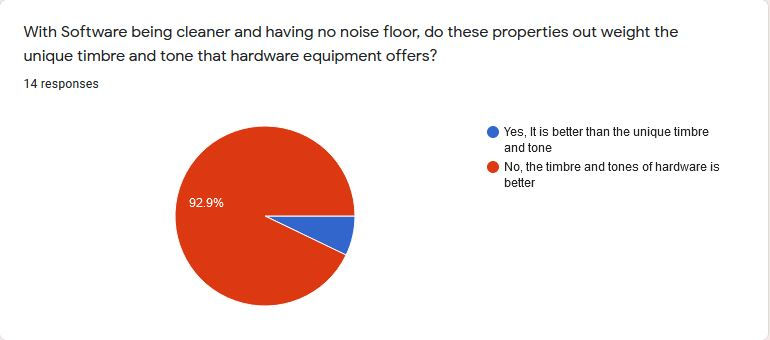


Conclusion
It is worth noting, that question 1, 7, 13, 19, 20, 24 and the pros & cons hardware/software questions were all in the pilot test so therefore unless the data is different this time, it only further backs up what was discovered in the pilot test